
What Is Data? – How It Is Stored And Its Types
In computer science, data are symbolic representations (i.e., numerical, alphabetical, algorithmic, etc.) of a certain attribute or a qualitative or quantitative variable: the coded description of an empirical fact, an event, an entity.
Therefore,it is the information (values or references) that the computer receives in various ways and that is manipulated through the processing of programming algorithms. Its content can be practically any: statistics, numbers, descriptors, which individually have no meaning for the system’s users, but can interpret together to obtain complete and specific information.
In programming languages used to create and organize the algorithms that any computer or computer system follows,.
It is the expression of the specific properties of the entities on which those algorithms operate. In other words, they are the first input from which the information can be processed and put together.
They are particularly important for it structure, a branch of computer science that studies the unique way in which information is stored in tiny pieces so that it can be efficiently found later.
Table of Contents
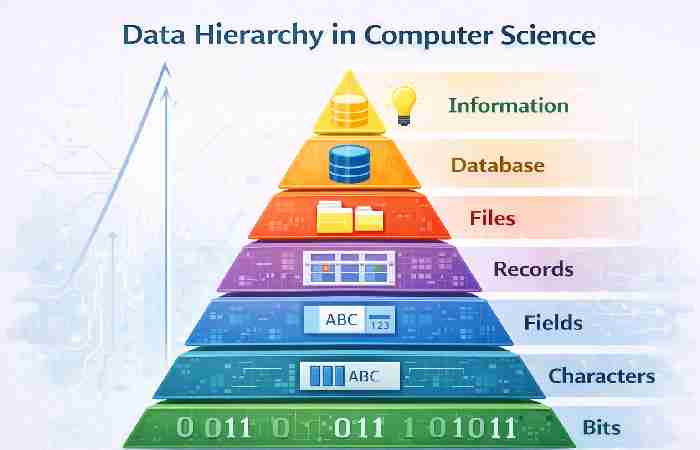
Visual Data Hierarchy Pyramid
Data vs Information in Computer Science
Many people search for “what is data vs information”. The difference is simple:
| Aspect | Data | Information |
| Meaning | Raw facts | Processed data |
| Structure | Unorganized | Structured |
| Example | 85, 90, 78 | Average score = 84 |
| Role | Input | Output |
Data becomes information only after processing.
Resource: IBM explains structured data concepts clearly here:
https://www.ibm.com/topics/structured-data
Structured vs Unstructured Data
Understanding data categories is essential in modern computing.
| Data Type | Definition | Example | Usage |
| Structured Data | Organized in rows/columns | Excel sheet | Databases |
| Semi-Structured Data | Has tags or markers | JSON, XML | APIs |
| Unstructured Data | No fixed format | Videos, emails | AI systems |
Today, over 80% of global data is unstructured.
How the data is stored
Computers represent it, including video, images, sounds, and text, as binary values using patterns of just two numbers: 1 and 0. A bit is the smallest unit of it and represents only one value. A byte has eight binary digits. Memory and memory measure in megabytes and gigabytes.
It metrics continue to grow with the amount of it collected and stored. The relatively new term “Brontobyte” is, for example, it storage that corresponds to 10 to the power of 27 bytes.
For example, it can be stored in file formats on mainframe systems using ISAM and VSAM. Other file formats for it storage, conversion, and processing include values separated by commas. These formats continued to find use on a wide variety of machine types, even as more structured, data-centric approaches to enterprise computing gained importance.
Modern Data Storage Methods (Cloud & Databases)
It storage has evolved beyond local hard drives.
- Major Storage Approaches
- Local storage (HDD/SSD)
- Cloud storage (AWS, Azure)
- Relational databases
- NoSQL databases
- Data lakes
Data Storage Units Explained
| Unit | Size | Description |
| Bit | 1 binary digit | Smallest unit |
| Byte | 8 bits | Basic storage unit |
| KB | 1,024 bytes | Small file |
| MB | 1,024 KB | Image file |
| GB | 1,024 MB | HD video |
| TB | 1,024 GB | Server storage |
| Brontobyte | 10²⁷ bytes | Massive theoretical scale |
Type of data
When we speak of data types (or simply “type”) in computer science, we mean an attribute presented to the computer on the kind of it available to process. This includes delimiting or restricting of it, defining the values it can take, what operations can perform on it, etc.
Some types of data are:
Characters Individual digits that can represent by numeric data (0-9), letters (az), or other symbols.
Unicode characters. Unicode is a coding standard that enables it to represent more efficiently and thus allows up to 65535 different characters.
Numerically. They can be real numbers or whole numbers as needed.
Boolean values. They represent logical values (true or false).
How Data Is Useful in Modern Fields
| Field / Industry | How Data Is Used | Example / Application | Benefit |
| Healthcare | Patient records, predictive analytics | Using EHRs and AI to predict disease outbreaks | Improved diagnosis, better patient care |
| Finance | Fraud detection, market analysis | Banks analyze transactions to detect fraud | Reduced losses, smarter investments |
| Retail & E-commerce | Customer behavior tracking | Online stores track buying patterns | Personalized marketing, higher sales |
| Education | Student performance analysis | EdTech platforms track learning progress | Customized learning, improved outcomes |
| Transportation & Logistics | Route optimization, demand forecasting | Delivery companies use GPS and traffic data | Reduced costs, faster deliveries |
| Agriculture | Crop monitoring, yield prediction | IoT sensors track soil moisture and weather | Higher yield, sustainable farming |
| Entertainment & Media | Content recommendations | Streaming platforms analyze watch history | Personalized suggestions, increased engagement |
| Manufacturing | Predictive maintenance | Sensors on machines monitor performance | Reduced downtime, lower repair costs |
Common Data Types in Programming
| Data Type | Example | Description | Operations Allowed |
| Integer | 10 | Whole number | +, -, *, / |
| Float | 10.5 | Decimal number | Math operations |
| Boolean | True/False | Logical value | AND, OR |
| Character | ‘A’ | Single symbol | Comparison |
| String | “Hello” | Text | Concatenation |
| Array | [1,2,3] | Ordered list | Indexing |
Data examples
Some examples of it maybe those that make up the hierarchy of computer data, in an ascending pyramid from the simplest to the most complex:
Bits. Each binary code language entry, i. H. 1 or 0.
Characters Numbers, letters, or special characters, each consisting of a combination of bits. Example: The decimal number 99 corresponds to 1100011 in binary format.
Fields. An ordered string of characters, such as a word such as the user’s first and last name, is filling out an online form.
Records. Sorted field sets as required to log in to our email.
Records. Sets of it records ordered, such as the cookies, that websites store in our system and contain information about the sessions we have initiated.
Information (in computer science)
In computer science, information is understood as ordered, sequential data processed by a programming algorithm. It enables us to reconstruct a reference point such as a concrete fact or a real meaning.
Therefore, retrieving information from packets or records is the ultimate goal of computing as computer systems encode.
It represent information through various mechanisms and languages that enable them to communicate with one another quickly and efficiently.
Global Data Growth Trends
| Year | Global Data Created (Zettabytes) |
| 2015 | 15 ZB |
| 2018 | 33 ZB |
| 2020 | 59 ZB |
| 2023 | 120 ZB |
| 2025 (Est.) | 181 ZB |
This shows exponential growth of digital data worldwide.
Why Data Management Matters Globally
Data drives:
- Artificial Intelligence
- Business analytics
- Healthcare systems
- Financial systems
- Cloud computing
Proper storage and classification improve:
- Speed
- Security
- Scalability
- Accuracy
Styled Section (Educational Highlight Box)
Quick Summary
Data is:
- Raw facts
- Stored in binary form
- Organized using structures
- Processed into information
- Growing at massive global scale
Conclusion
Data is the foundation of modern computing. From simple binary bits to massive global cloud databases, everything in technology depends on structured storage and intelligent processing. Understanding it types, storage formats, and hierarchy helps developers, students, and businesses manage digital information effectively.
As digital transformation accelerates worldwide, mastering it concepts is no longer optional—it is essential.
