
Benefits Of AI In Banking And Finance

Banks and financial institutions are under constant pressure to work faster, reduce costs, and deliver better customer experiences. That’s where AI in banking and finance comes in. Instead of relying only on manual processes and traditional systems, banks now use artificial intelligence to detect fraud, automate routine tasks, analyze huge amounts of data, and personalize services for customers. From chatbots that answer questions instantly to smart systems that predict credit risk, AI in banking and finance is helping the industry become more efficient, secure, and customer-focused in a rapidly changing digital world.
Table of Contents
Global Market Growth of AI in Banking
Artificial intelligence adoption in financial services is accelerating across regions.
Global AI in Banking Market Growth
| Year | Global Market Value (USD Billion) | Growth Trend |
| 2021 | 15.1 | Strong |
| 2023 | 24.5 | Rapid |
| 2025 (Projected) | 38.7 | Accelerating |
| 2030 (Projected) | 97+ | Transformational |
The expansion of AI in banking reflects increased investment in automation, fraud detection, and digital personalization.
High competition and declining profit margins are forcing banks to look for new ways to improve efficiency. One of the main magic wands is Artificial Intelligence (AI), which gives some people more than double the CAGR and an additional billion-dollar profit center for others, so today we are learning more about AI in banking.
Why Banks Are Investing in AI Technologies
Banks are focusing on AI adoption for measurable performance gains.
Key Drivers of AI in Finance Adoption
| Business Challenge | How AI Helps |
| High operational costs | Process automation |
| Fraud and cybercrime | Real-time anomaly detection |
| Customer churn | Predictive analytics |
| Regulatory pressure | Automated compliance monitoring |
| Manual data processing | Intelligent data extraction |
According to McKinsey research:
https://www.mckinsey.com/capabilities/quantumblack/our-insights/the-state-of-ai
Financial institutions that fully integrate AI in banking workflows report higher productivity and improved decision-making.
The finance industry is showing a strong interest in the development of artificial intelligence (AI) technologies. Recently, banks have announced their implementation in their organizations and the intensification of their use. Experts believe that over the next five years there will be a qualitative shift in the banking service due to the introduction of AI systems and, perhaps, after a while the bank’s client will be ready to pay for communication with a living person.
Core Applications of AI in Banking
Artificial intelligence supports multiple banking functions.
Major AI in Banking Applications
| Application Area | Description | Impact Level |
| Chatbots & Virtual Assistants | 24/7 customer interaction | High |
| Fraud Detection | Real-time transaction monitoring | Very High |
| Credit Scoring | Predictive borrower analysis | High |
| Risk Management | Market & insider risk modeling | High |
| Algorithmic Trading | AI-based securities decisions | Medium–High |
The expansion of AI in banking is especially visible in fraud detection and digital customer service.
Artificial intelligence will help banks to significantly automate processes and improve the quality of customer service, analysts say.
Of course, it will not be possible to completely replace a person, and in the near future, one should not expect banking systems fully controlled by AI. Yes, this is probably not necessary. Nevertheless, artificial intelligence is able to automate the same type of banking processes and improve customer service using chatbots. Artificial intelligence is one of the most promising financial technologies.
AI in Banking Use Cases by Department
Department-Level AI Implementation
| Banking Department | AI Use Case |
| Retail Banking | Smart recommendations & chatbots |
| Corporate Banking | Credit risk modeling |
| Investment Banking | Algorithmic trading |
| Compliance | AML pattern recognition |
| Operations | Automated document processing |
Key Operational Improvements
- Reduced manual workload
- Faster transaction processing
- Lower fraud losses
- Personalized financial products
AI-driven transformation continues to reshape traditional banking structures.
It is likely that banks will incorporate AI into their applications in the next two or three years. There has been an increase in demand for cost-effective operations while delivering exceptional levels of service and lower costs.
Artificial intelligence solves many problems, the main one of which is customer service. AI makes it possible to adapt various banking instruments to the needs of different users, which significantly increases the level of service.
In addition, banks use AI systems in organizing various operations, in the field of risk management, especially those related to insiders, in investing in securities. The use of artificial intelligence allows banks to minimize the role of the human factor, automate many processes, resulting in cost savings, and solve a number of standards, typical tasks. For example, bots in the chat of the Telegram messenger provide round-the-clock customer support seven days a week, instantly answer questions from chat users, making it possible not to involve live employees in this.
Technologies Behind AI in Finance
AI systems operate through advanced computational methods.
Core Technologies Powering AI in Banking
| Technology | Function |
| Machine Learning | Pattern recognition in large datasets |
| Natural Language Processing (NLP) | Chatbots & sentiment analysis |
| Predictive Analytics | Forecasting financial risks |
| Robotic Process Automation (RPA) | Repetitive task automation |
| Big Data Infrastructure | Large-scale information processing |
The integration of these technologies strengthens the competitive position of banks implementing AI in banking models.
Artificial intelligence technologies themselves are based on mathematical statistics and machine learning methods. Artificial intelligence technologies can be effectively applied in processes in which the result is dependent on input data or on feedback on data input. One of the most interesting ways of using this technology in a bank is the introduction of chatbots in the process of initial communication with a client. But the field of application of artificial intelligence is much broader.
Artificial intelligence, which at the moment is in fact equivalent to the use of Big Data and Data mining technologies, is most effective in those areas where high-quality processing of information by a person is impossible or impractical. Artificial intelligence technologies can be applied in a wide variety of areas of banking, from chatbots to the securities market
If you want to apply such technologies, then you can safely contact DICEUS and make all your ideas come true.
How AI Systems Work Inside a Modern Bank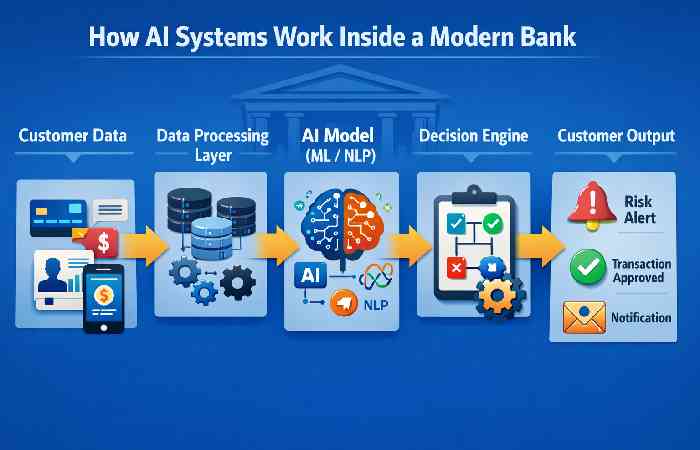
This visual representation helps explain how AI in banking processes data in real time for operational decisions.
Benefits, Risks, and Future Outlook
Benefits vs Risks of AI in Banking
| Benefits | Risks |
| Cost reduction | Data privacy concerns |
| Faster decision-making | Model bias |
| 24/7 customer service | Cybersecurity threats |
| Fraud prevention | Regulatory uncertainty |
| Scalable operations | Ethical challenges |
Future Outlook Points
- Expansion of AI-powered credit underwriting
- Greater personalization in digital banking
- Increased regulatory AI oversight
- AI-human hybrid advisory models
The long-term evolution of AI in banking suggests a hybrid model, where automation supports but does not fully replace human expertise.
Final Perspective
The financial sector is undergoing structural change driven by automation and analytics. AI in banking is no longer experimental; it is becoming foundational infrastructure. From fraud detection to predictive lending, institutions leveraging AI in finance gain operational efficiency, strategic insight, and competitive advantage.
As global adoption increases, the success of AI in banking will depend on responsible implementation, regulatory alignment, and continued technological advancement.
