
How To Build Your Own Artificial Intelligence App For Business?

Building an Artificial Intelligence App for business is no longer limited to tech giants. With AI projected to surpass $260 billion globally, companies across industries are investing in AI-powered solutions like predictive analytics, chatbots, automation tools, and smart assistants. Whether you’re creating a machine learning app, AI business solution, or enterprise automation platform, understanding the global landscape, cost factors, and infrastructure requirements is essential.
Table of Contents
Global Market Opportunity for Artificial Intelligence App Development
Global AI Market Growth
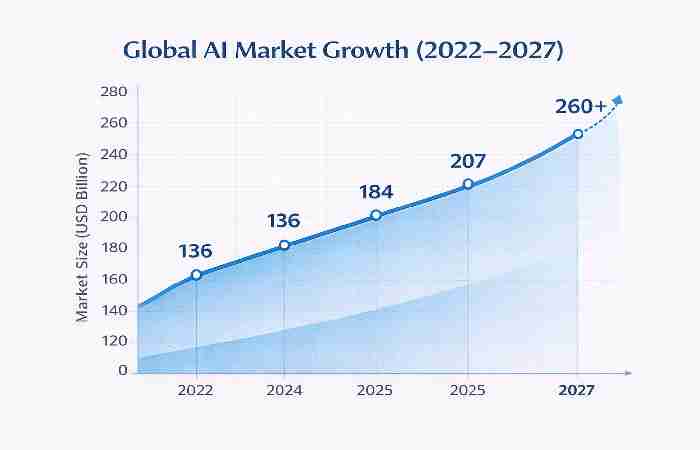
| Year | Market Size (USD Billion) |
| 2022 | 136 |
| 2024 | 184 |
| 2025 | 207 |
| 2027 | 260+ |
Source reference:
World Economic Forum AI Industry Insights
https://www.weforum.org
Key Insight: AI adoption is highest in the US, China, UK, India, and Canada.
Top 10 Businesses in the World Using an Artificial Intelligence App
| Rank | Company | Country | AI Application Type | Primary Business Use | Estimated AI Investment |
| 1 | Amazon | USA | AI Recommendation Engine, Alexa | Personalized shopping, logistics optimization | $75B+ annually (AI + Cloud) |
| 2 | Alphabet Inc. | USA | Search AI, DeepMind | Search algorithms, ads optimization | $40B+ annually |
| 3 | Microsoft | USA | Azure AI, Copilot | Enterprise AI tools & cloud services | $30B+ annually |
| 4 | Meta Platforms | USA | AI Content Ranking | Social media algorithms, ads targeting | $25B+ annually |
| 5 | Tesla | USA | Autonomous Driving AI | Self-driving systems | $10B+ annually |
| 6 | Alibaba Group | China | AI Retail & Cloud | Smart logistics & e-commerce | $15B+ annually |
| 7 | Tencent | China | AI Gaming & Fintech | Smart gaming engines & payments | $8B+ annually |
| 8 | IBM | USA | Watson AI | Enterprise AI solutions | $6B+ annually |
| 9 | NVIDIA | USA | AI Chips & Platforms | AI hardware infrastructure | $20B+ annually |
| 10 | ByteDance | China | AI Content Algorithm | Personalized video feed | $5B+ annually |
Which Company Is 1st in Artificial Intelligence App Usage?
Amazon ranks 1st globally
Why Amazon is #1 in Artificial Intelligence App adoption:
- AI-powered product recommendation engine
- AI-driven warehouse robotics
- Alexa voice AI system
- Advanced logistics & predictive inventory
- AWS AI cloud services powering millions of apps worldwide
- Amazon’s AI ecosystem impacts:
- E-commerce
- Cloud computing
- Smart assistants
- Supply chain automation
This makes it the most diversified and commercially integrated Artificial Intelligence App ecosystem in the world.
AI Adoption Categories Comparison
| Category | Leading Company |
| E-commerce AI | Amazon |
| Search & NLP AI | Alphabet |
| Enterprise AI | Microsoft |
| Social Media AI | Meta |
| Autonomous AI | Tesla |
| AI Hardware | NVIDIA |
Why Use an Artificial Intelligence App in Business?
Using an Artificial Intelligence App helps businesses automate processes, improve decision-making, reduce costs, and increase revenue through data-driven intelligence. Today, leading global companies like Amazon, Microsoft, and Alphabet Inc. use AI-powered applications to stay competitive and scale globally.
Core Reasons to Use an Artificial Intelligence App
| Reason | What It Does | Business Impact |
| Automation | Handles repetitive tasks | Saves time & labor costs |
| Data Analysis | Processes large datasets instantly | Better decision-making |
| Personalization | Customizes user experience | Higher customer engagement |
| Prediction | Forecasts trends & demand | Reduces risk |
| 24/7 Availability | Chatbots & smart assistants | Improved customer support |
| Fraud Detection | Identifies suspicious activity | Increased security |
1. Improves Efficiency
AI apps automate routine operations such as:
- Data entry
- Customer queries
- Inventory updates
- Report generation
This reduces human error and increases operational speed.
2. Enhances Decision-Making
An Artificial Intelligence App can:
- Analyze millions of data points
- Detect hidden patterns
- Provide predictive insights
For example, AI can forecast sales trends or identify which customers are likely to churn.
3. Reduces Operational Costs
AI reduces dependency on large manual teams by:
- Automating workflows
- Optimizing supply chains
- Minimizing waste
Companies often see cost reductions of 20–40% after AI integration.
4. Improves Customer Experience
AI-powered:
- Chatbots
- Recommendation engines
- Voice assistants
These tools personalize the user journey and increase customer satisfaction.
5. Provides Competitive Advantage
Businesses using AI:
- Launch products faster
- Respond to market changes quicker
- Offer smarter services
This creates a strong competitive edge in global markets.
ROI of Using an Artificial Intelligence App
| Year After Implementation | Average ROI Increase |
| Year 1 | 15–25% |
| Year 2 | 30–45% |
| Year 3 | 50%+ |
Plan Your AI Application
First, you should plan your AI application for business. Ideally, you should identify what processes and functions you want to use your AI application for. Of course, you should also decide what results you want to get and how your company will benefit. Once you’ve defined the problem, create a clear list of product requirements for your project.
Using these requirements, you can start to choose members for your development team. For example, you may need to hire a business analyst, project manager, or data engineer. If you are new to programming, you should also hire an experienced backend developer. Then, you can draw up a schedule and begin exploring the data you need. Absolutely, create a well-defined plan for your artificial intelligence business application.
Business Use Cases for an Artificial Intelligence App
AI Business Use Case Table
| Industry | AI Application | Business Impact |
| Finance | Loan risk prediction | Reduced default risk |
| Retail | Customer recommendation engine | Increased sales |
| Healthcare | Diagnostic AI tools | Faster decision-making |
| E-commerce | Chatbots & automation | 24/7 customer support |
| Logistics | Route optimization | Cost reduction |
Key Benefits
- Automates repetitive tasks
- Reduces operational errors
- Improves customer experience
- Enhances data-driven decision-making
Install An Advanced Container Registry
Next, you should install an advanced container registry before you build your AI application. For example, you can install a JFrog container registry to manage your repositories. In addition, you can also integrate a Helm repository into this containerization software. Once installed, you can access privacy, reliable availability, and massively scalable storage for your app. In addition, many enterprise developers use this tool to optimize their automation scripts and make them more efficient.
Then, they can facilitate automated software delivery for their Kubernetes deployments. Notably, platforms built on containerization can collect, organize, and process data for analytics. Thus, container registries are a great tool to support your AI app architecture.
AI App Infrastructure & DevOps Stack
AI Development Infrastructure Table
| Component | Purpose | Popular Tools |
| Container Registry | App deployment | Docker Hub, JFrog |
| Cloud Platform | Hosting & ML services | AWS, Azure, GCP |
| CI/CD Tools | Automation | GitHub Actions |
| Database | Data storage | MongoDB, PostgreSQL |
| Kubernetes | Scalability | Kubernetes Engine |
Modern AI app architecture relies heavily on cloud-native and containerized environments.
Choose Your AI & ML API Solutions
Once you install your container registry, you should choose your artificial intelligence and machine learning (ML) API solutions. Typically, your choice will depend on your application requirements and the AI capabilities you need. For example, some API solutions allow you to identify objects, people, and text. This is great if you are building a software with facial or image recognition. In addition, you some APIs offer keyphrase extraction, syntax analysis, and language detection features.
If you are building a natural language processing system, these are essential to create a functioning model of your software. Of course, you can also use cloud platforms to build machine learning pipelines as well. Undoubtedly, choose your AI and ML API solutions to start building your software.
Popular AI APIs and Platforms by Country
AI API Pricing & Availability in 5 Countries
| Country | Popular AI Platform | Starting Cost | Online Access |
| USA | AWS AI / Google Cloud AI | $0.002 per API call | aws.amazon.com |
| UK | Azure AI | £0.0015 per request | azure.microsoft.com |
| India | Google AI APIs | ₹0.15 per 1000 characters | cloud.google.com |
| Canada | IBM Watson | CAD 0.003 per call | ibm.com |
| Australia | AWS AI Services | AUD 0.002 per call | aws.amazon.com |
Costs vary depending on usage volume and computing requirements.
Select Your Algorithm
Moreover, choose your algorithm to build your AI system. For example, you can use a supervised learning algorithm to leverage a given dataset. Typically, these algorithms train themselves to provide the required results based on the test data. This is a great option if you’re looking to build a finance app that offers loan insights.
In addition, you can use an unsupervised learning algorithm. Usually, this type of algorithm tries to group things by clusters based on associations. Indeed, it may try to find the links between objects or reduce the number of variables to decrease the noise. Once you choose your algorithm, you should train it to get to your desired accuracy level. Certainly, selecting your algorithm is a key step to build your AI application for business.
Algorithm Selection Comparison Table
AI Algorithm Comparison
| Algorithm Type | Best For | Example Business Use |
| Supervised Learning | Prediction | Credit scoring |
| Unsupervised Learning | Pattern detection | Customer segmentation |
| Reinforcement Learning | Decision optimization | Dynamic pricing |
| NLP Models | Language processing | Chatbots |
| Computer Vision | Image recognition | Fraud detection |
Develop A Minimum Viable Product
Furthermore, you should develop a minimum viable product to build your AI app. To develop this, you should select the most useful features for your end-users. Then, make sure your application can carry them out to perfection before your launch. Of course, you should also keep your audience in mind as you choose your features. For example, you should think about the types of questions your audience might ask if you are building a chat bot. You might even segment different types of questions based on different age demographics in your audience. Certainly, develop a minimum viable product to build your own artificial intelligence app.
There are several important steps to build your own AI app for business. First, you should plan your app’s requirements and personnel. Next, install an advanced container registry to access scalable storage and support your architecture. In addition, choose your AI and machine learning success API solutions for your app. Moreover, select and train an algorithm that works for your software. Furthermore, develop a minimum viable product that meets your target audience’s needs. Consider these points highlighted above to learn how to build your own AI app for business.
Cost of Building an Artificial Intelligence App in 5 Countries
AI App Development Cost Comparison
| Country | Avg Development Cost | Developer Hourly Rate | Online Hiring Platforms |
| USA | $80,000–$250,000 | $100–$180/hr | Upwork, Toptal |
| UK | $60,000–$200,000 | £70–£150/hr | PeoplePerHour |
| India | $25,000–$80,000 | $25–$60/hr | Freelancer, Upwork |
| Canada | $70,000–$220,000 | CAD 90–160/hr | Toptal |
| Australia | $75,000–$210,000 | AUD 100–170/hr | Seek, Upwork |
ROI of AI Adoption in Businesses
| Year After Deployment | ROI Increase |
| Year 1 | 15–25% |
| Year 2 | 30–45% |
| Year 3 | 50%+ |
Pro Insight:
Businesses that integrate AI early gain competitive advantages through automation, predictive insights, and personalized customer engagement. The key is not just building an Artificial Intelligence App—but aligning it with measurable business goals.
Updated Conclusion
Building your own Artificial Intelligence App requires strategic planning, scalable infrastructure, smart algorithm selection, and global awareness of costs and platforms. Whether you’re developing in the US, UK, India, Canada, or Australia, AI implementation is becoming more accessible and business-critical. Companies that adopt AI today are positioning themselves for long-term growth, efficiency, and innovation.
