
Limitations and Benefits of Machine Learning Explained
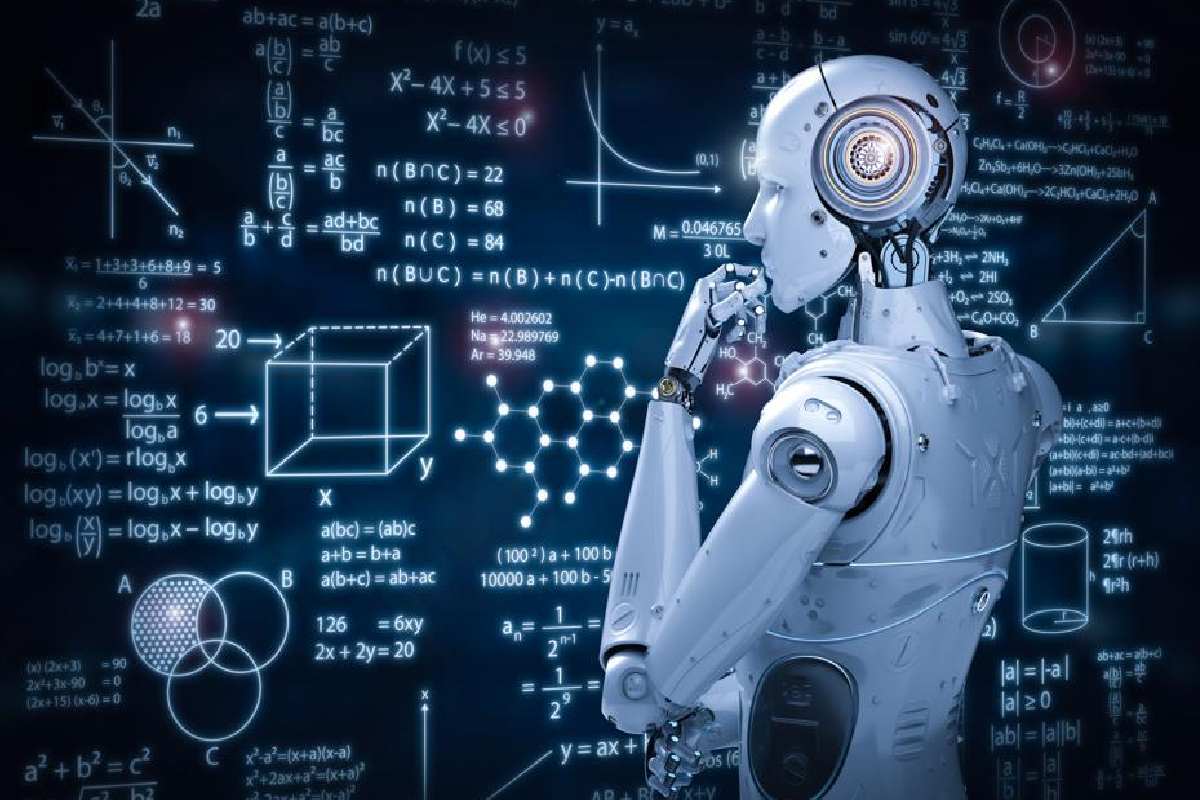
Machine learning is rapidly changing how computers work and how people interact with technology. It allows systems to analyze data, recognize patterns, and improve their performance without being directly programmed for every task.
Today, computers are no longer limited to offices or laboratories. Smartphones, smart home devices, and even modern refrigerators can automate tasks and make smart decisions using advanced artificial intelligence technologies. Because of these innovations, interest in technology education has increased worldwide, with many students and professionals exploring online courses and certification programs to understand how intelligent systems operate.
And now sometimes it is not clear with whom you are communicating: with a living person or with a computer.
Table of Contents
What Is Machine Learning?
Machine learning is a branch of artificial intelligence and machine learning technologies that allows computers to learn from data without being explicitly programmed. Instead of following fixed instructions, algorithms analyze patterns, improve predictions, and automatically adapt as more data becomes available.
In simple terms, it for beginners can be explained as teaching computers to recognize patterns the same way humans learn from experience.
For example:
| Real World Example | Machine Learning Task |
| Email spam filters | Detect spam messages |
| Netflix recommendations | Suggest movies |
| Google search | Rank web pages |
| Self-driving cars | Identify road signs |
| Online shopping | Recommend products |
The reason learning courses and certifications have become extremely popular worldwide is that almost every industry now uses ML technology.
Key characteristics of machine learning:
- Works with large data sets
- Improves accuracy over time
- Identifies hidden patterns
- Automates decision making
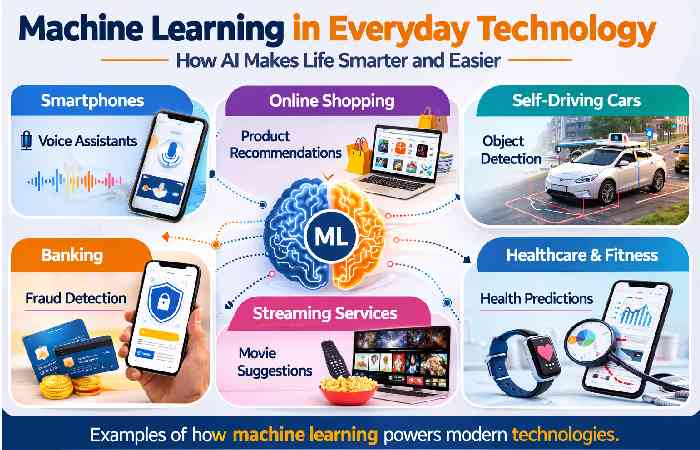
It powers many modern technologies including voice assistants, fraud detection systems, and predictive analytics tools.
Machine Learning in Everyday Technology
Types of Machine Learning
Supervised Learning:
This type of learning is identical to the process of learning “everything in the world” by a child; the algorithm itself acts as a child. The data that give the algorithm for analysis already have the correct answer. Based on this, it should be said that the purpose of this action is to teach the algorithm not only to find the correct answer but also to understand what and why. The result is the ability to build correct forecasts and models.
Unsupervised learning:
Is a machine learning method in which you don’t have to control the model. Instead, you need to let the model work on its own to discover the information. This is mainly true for unlabeled data.
Reinforcement learning:
The principles of reinforcement learning are borrowed from psychological experiments: the machine needs to take one or another action in different scenarios. Each action entails certain consequences, both short-term and long-term. The algorithm must analyze all possible options for further events and choose the optimal action at the present time.
Machine learning tools are used in the following stages:
- collection and preparation of data;
- building a model;
- training and deployment of applications.
Artificial Intelligence and Machine Learning Relationship
Many people confuse artificial intelligence and it, but they are not the same thing.
Artificial intelligence (AI) is the broader concept of machines performing tasks that normally require human intelligence. It is a subset of AI that focuses on learning from data.
| Technology Field | Description |
| Artificial Intelligence | Systems that mimic human intelligence |
| Machine Learning | Algorithms that learn from data |
| Deep Learning | Neural network based ML models |
| Data Science | Extract insights from data |
For example:
- AI: A robot assistant
- ML: The algorithm that helps the robot learn tasks
- Deep learning: Neural networks that help it recognize objects
This connection is why many universities offer AI machine learning courses together.
Learning artificial intelligence and machine learning together helps students understand:
- Intelligent automation
- Pattern recognition
- Predictive analytics
- Decision-making models
Key Machine Learning Algorithms Explained
It relies on mathematical algorithms that learn patterns from data.
Below are some of the most widely used its algorithms used in real-world systems.
| Algorithm | Type | Use Case |
| Linear Regression | Supervised | Predict numerical values |
| Decision Tree | Supervised | Classification and predictions |
| Support Vector Machine (SVM) | Supervised | Image recognition |
| K-Means Clustering | Unsupervised | Customer segmentation |
| Random Forest | Supervised | Fraud detection |
| Neural Networks | Deep learning | Voice recognition |
Linear Regression in Machine Learning
Linear regression predicts numerical outcomes by identifying relationships between variables.
Example uses:
| Industry | Prediction Example |
| Real Estate | House price prediction |
| Finance | Stock price trend |
| Marketing | Sales forecasting |
Decision Tree in Machine Learning
A decision tree is a model that splits data into branches based on conditions.
Example decision path:
Is income > $50k?
yes → approve loan
no → check credit score
Advantages:
- Easy to interpret
• Fast training
• Works with structured data
SVM in Machine Learning
Support Vector Machines classify data by finding the best boundary between different categories.
Example uses:
| Application | Purpose |
| Face recognition | Identify people |
| Medical diagnosis | Detect diseases |
| Text classification | Spam detection |
Clustering in Machine Learning
Clustering groups similar data without labels.
Example:
| Customer Group | Behavior |
| Group A | Frequent buyers |
| Group B | Seasonal buyers |
| Group C | Discount shoppers |
Clustering helps companies understand customers better.
Machine Learning Applications Around the World
It is transforming industries globally.
| Industry | Machine Learning Application |
| Healthcare | Disease prediction |
| Finance | Fraud detection |
| Retail | Product recommendations |
| Transportation | Self-driving cars |
| Agriculture | Crop prediction |
| Cybersecurity | Threat detection |
Example global companies using ML:
| Company | ML Use |
| Search algorithms | |
| Amazon | Product recommendations |
| Tesla | Autonomous driving |
| Netflix | Content suggestions |
Because of these uses, it projects have become a key part of modern education.
Examples of beginner projects:
- Spam email classifier
- House price predictor
- Movie recommendation system
- Stock trend predictor
Limitations and Cons of Machine Learning
The first disadvantage is that the car lacks any kind of ethics. When we teach the machine something unusual and antiethical, the consequences can be completely unpredictable.
Unfortunately, a huge number of machine learning algorithms work not for the good of society, but for the good of their creators, observing only their personal interests.
False correlation is when things that do not depend on each other behave as much as possible in the same way and, as a result, one gets the impression that they are somehow connected.
Only feedback loops are worse than false correlations. This is when the decisions of the algorithm affect reality, which, in turn, further convinces the algorithm of its point of view.
Poisoning is an impact on the learning process. But you can also deceive a ready-made, properly working mathematical model, if you know how it works. For example, a group of researchers managed to learn how to deceive the face recognition algorithm using special glasses that make minimal changes to the picture and thereby radically change the result.
Risks and Limitations of Machine Learning
| Risk | Explanation |
| Bias | Algorithms learn biased data |
| False Correlation | Wrong pattern detection |
| Data Poisoning | Manipulated training data |
| Ethical Concerns | Lack of moral judgment |
| Feedback Loops | Reinforcing wrong decisions |
Benefits of Machine Learning
It provides powerful advantages for businesses, researchers, and governments.
| Benefit | Explanation |
| Automation | Reduces manual work |
| Accuracy | Improves predictions |
| Speed | Processes massive data |
| Scalability | Works with growing data |
| Personalization | Customized user experiences |
Global Impact
Machine learning systems help:
- Diagnose diseases earlier
- Detect financial fraud
- Improve transportation safety
- Optimize energy usage
This is why the demand for it certification programs is increasing globally.
Machine Learning Full Course and Certifications
Its full course usually includes several modules covering mathematics, programming, and algorithm design.
| Course Module | Topics Covered |
| Introduction | What is machine learning |
| Python Programming | NumPy, Pandas |
| Statistics | Probability & distributions |
| Algorithms | Regression, SVM, clustering |
| Deep Learning | Neural networks |
| Projects | Real-world ML systems |
Typical machine learning courses duration:
| Level | Duration |
| Beginner | 4–6 weeks |
| Intermediate | 3 months |
| Professional certification | 6–12 months |
Popular course providers worldwide:
| Platform | Program |
| Coursera | ML specialization |
| edX | AI and ML programs |
| Udacity | ML nanodegree |
| TensorFlow courses |
Resource Link
Google Machine Learning Crash Course
https://developers.google.com/machine-learning/crash-course
This resource includes:
- Beginner’s explanation of what machine learning
- Practical machine learning algorithms
- Examples of linear regression
- Exercises and tutorials for beginners
It is widely used by students and professionals learning machine learning courses globally.
Future of Machine Learning
It is expected to become one of the most influential technologies of the 21st century.
Experts predict major advancements in:
| Future Trend | Impact |
| Autonomous vehicles | Safer transportation |
| AI healthcare | Faster disease detection |
| Smart cities | Efficient infrastructure |
| Personal AI assistants | Advanced automation |
| Climate modeling | Better environmental predictions |
The combination of learning artificial intelligence, advanced data science, and powerful computing will continue to drive innovation worldwide.
It will not replace humans entirely, but it will dramatically enhance decision-making, productivity, and technological progress.
