
Ransomware Starts Earlier Than You Think: The Pre-Breach Signals Security Teams Miss
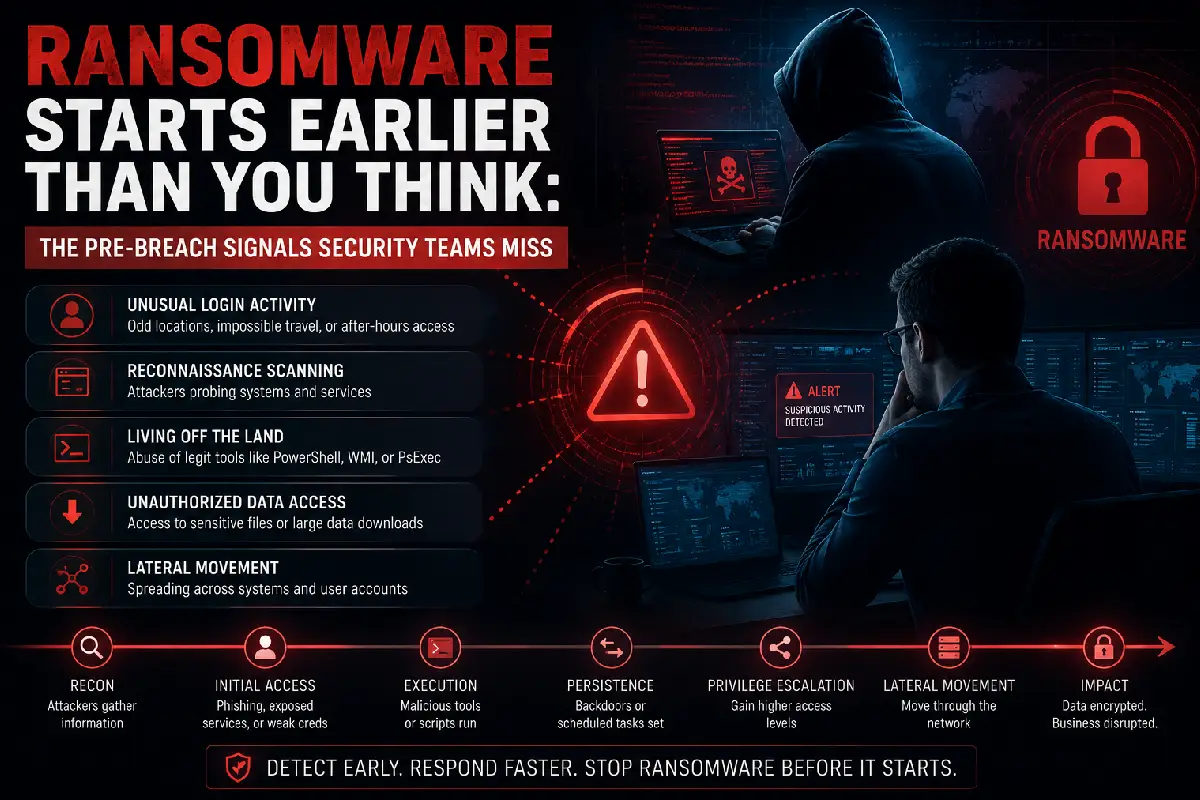
Table of Contents
The Ransomware Attack Begins Before the Ransom Note
Ransomware is often treated as a dramatic final event: encrypted systems, stolen data, business interruption, public extortion, and urgent executive decisions. In reality, the attack begins much earlier. The ransom note is usually the last visible stage of a chain that may start with a leaked credential, an exposed remote access service, an infostealer infection, a vulnerable public-facing system, or a conversation in a criminal marketplace.
This earlier phase is where security teams have the greatest opportunity to change the outcome. Before ransomware operators deploy payloads, they need access, persistence, reconnaissance, privilege, and confidence. Each of these stages can create signals. Some appear inside the enterprise. Many appear outside it, across stealer logs, dark web forums, Telegram channels, access broker listings, code repositories, paste sites, and attacker infrastructure.
The main challenge is visibility. Companies often discover ransomware when the business impact is already clear. The stronger approach is to monitor for the signals that show attackers are preparing, shopping, testing, and positioning themselves for a future intrusion.
Initial Access Has Become a Supply Chain
Modern ransomware is supported by a specialized criminal economy. One group may steal credentials. Another group may scan for vulnerable systems. Another may sell remote access. Another may deploy ransomware and negotiate payment. This division of labor allows attacks to move faster and scale across many industries.
Initial access brokers play a key role in this model. They obtain footholds into corporate environments and sell them to ransomware affiliates or other criminal buyers. The access may involve VPN accounts, RDP credentials, cloud portals, SaaS accounts, web shells, exposed admin panels, or compromised supplier identities. For the buyer, this shortens the attack path. For the victim, it creates early warning signals outside the network.
An access listing that mentions a company’s industry, geography, revenue, technology stack, VPN product, or domain can be the first sign of a future ransomware incident. Security teams that monitor these markets can identify risk before the access is used. This is the difference between responding to an intrusion and disrupting the supply chain that enables it.
Stolen Credentials Are a Pre-Breach Signal
Stolen credentials are among the most important early indicators of ransomware risk. They give attackers a direct path into systems where legitimate access creates fewer alarms than malware. A valid account can pass through identity providers, reach SaaS applications, connect to VPNs, open cloud consoles, read email, and access shared drives.
Credential exposure often begins with infostealer malware. A user’s device gets infected, and the malware extracts browser passwords, cookies, tokens, autofill data, screenshots, and system information. The stolen data is then packaged into logs and distributed through criminal channels. These logs can contain corporate accounts from managed devices, unmanaged personal laptops, contractor machines, and vendor systems.
The business meaning is simple: a company’s ransomware risk may begin on a device it does not manage. An employee who used a personal browser to access work email, a contractor who saved a VPN password, or a vendor with access to a shared portal can all become part of the exposure surface. A leaked credential tied to a sensitive system should be treated as a live ransomware signal, especially when the account has privileged access or connects to critical operations.
Vulnerability Exploitation Creates a Different Kind of Warning
Ransomware also starts with exposed technology. Public-facing applications, VPN gateways, remote monitoring tools, file-transfer systems, identity infrastructure, and cloud workloads often become entry points when attackers exploit known vulnerabilities. The warning signs can appear before exploitation at scale: new proof-of-concept code, attacker chatter, scanning activity, vendor advisories, exploit sales, and sudden attention around a specific product.
Security teams often track vulnerabilities through internal patching queues. Ransomware defense requires an attacker-centered view of vulnerability exposure. The most urgent question is which vulnerabilities are being weaponized by criminal groups, which exposed systems are reachable from the internet, and which assets support critical business processes.
A vulnerability on an isolated test system carries one level of urgency. A vulnerability on a remote access service connected to production, finance, identity, or backups carries another. The pre-breach signal becomes powerful when external exploit intelligence is matched with internal asset context.
Criminal Chatter Often Comes Before the Attack
Ransomware groups, affiliates, brokers, and data sellers leave traces before a victim becomes public. They discuss access, seek buyers, advertise footholds, request exploit help, trade credentials, and negotiate partnerships. Some posts are vague. Others include enough details to identify a target, sector, geography, revenue range, technology stack, or domain.
This type of chatter helps security teams understand intent. A company name mentioned in a criminal channel may indicate reconnaissance, available access, data possession, or planned extortion. A post offering access to a “manufacturing company in Europe with VPN access” may become relevant to any matching organization in that profile. A discussion around exploiting a specific vendor product may give defenders time to prioritize exposure checks.
The value of this signal depends on context and speed. Criminal chatter becomes actionable when it can be connected to the company’s assets, identities, suppliers, and sensitive systems. The goal is to move from passive monitoring to early intervention.
The Backup and Identity Signals Security Teams Miss
Ransomware operators care about leverage. They want access to data, operational systems, backups, identity infrastructure, hypervisors, cloud storage, and executive communication. Their behavior before encryption often reveals these goals.
A security team may see unusual access to backup systems, new administrative logins, privilege changes, remote management tool usage, mailbox rule creation, mass file discovery, cloud storage enumeration, disabled security controls, or attempts to access virtual infrastructure. Each signal may look like an isolated IT event. Together, they can show ransomware preparation.
Identity signals are especially important. Ransomware operators often move through the environment using legitimate accounts. They may create new accounts, add users to privileged groups, register new MFA devices, generate API keys, approve OAuth applications, or access administrative consoles at unusual times. These actions deserve higher priority when the identity involved also appears in external exposure sources.
The strongest security programs connect these signals into a story. External exposure shows what attackers may have. Internal telemetry shows what they are doing. Business context shows what they can damage.
Third-Party Access Expands the Pre-Breach Surface
Ransomware often enters through trusted relationships. Vendors, IT service providers, agencies, contractors, and managed service providers can all carry access into a company’s environment. Their credentials, remote tools, and support accounts may be attractive to attackers because they connect to multiple customers.
A third-party credential in a stealer log, a supplier account advertised by an access broker, or criminal chatter around a shared technology provider can all become pre-breach signals. These signals sit outside traditional internal monitoring, yet they can point directly to enterprise risk.
This is why supplier access governance should be part of ransomware readiness. Companies need to know which third parties can access critical systems, which accounts are active, which permissions are granted, which authentication controls apply, and which vendors have exposure in criminal sources. Third-party identity is part of the ransomware attack surface.
Speed Matters More Than Alert Volume
Ransomware defense is a race against conversion. Attackers convert exposure into access, access into privilege, privilege into data theft, and data theft into extortion. Every delay increases the attacker’s options.
Security teams often receive more alerts than they can process. The answer is better prioritization, not more noise. A credential exposure tied to a finance administrator deserves immediate action. A vulnerability being exploited by ransomware groups on an internet-facing system deserves urgent escalation. A criminal forum post advertising access to a company’s sector and technology stack deserves investigation. A suspicious login from an exposed identity deserves stronger response than a generic anomaly.
Pre-breach defense depends on the ability to rank signals by business impact. The most useful signals combine freshness, source reliability, asset sensitivity, identity privilege, attacker intent, and exploitability. This allows teams to focus on the exposures most likely to become incidents.
From Ransomware Response to Pre-Breach Operations
Many companies have ransomware playbooks for the moment of crisis. They define escalation paths, legal steps, communications plans, backup restoration, forensic response, and executive decision-making. Mature programs also need pre-breach operations.
Pre-breach operations bring together cyber threat intelligence, identity security, vulnerability management, attack surface management, SOC workflows, and third-party risk. The operating model is simple: find early signals, connect them to internal context, trigger containment, and measure the time from exposure to action.
When a credential appears in a stealer log, the process should revoke sessions, reset credentials, rotate tokens, review recent activity, and investigate the source device. When a critical exposed system matches active ransomware exploitation, the process should drive emergency patching, isolation, compensating controls, and executive visibility. When criminal chatter points to available access, the process should validate assets, identities, logs, and supplier exposure.
The purpose is to reduce the attacker’s runway before the ransomware stage begins.
What Security Leaders Should Measure
Security leaders should measure ransomware readiness through early-stage metrics. The most useful metrics show how quickly the organization detects and contains the signals that precede ransomware.
Time from credential exposure to containment is one of the most important measures. So is the percentage of exposed identities tied to active accounts, the number of privileged users covered by phishing-resistant authentication, the time to patch externally exploited vulnerabilities, the number of internet-facing critical assets with known exposure, and the volume of third-party accounts with sensitive access.
These metrics create a board-level view of ransomware risk. They show whether the organization can act before impact. They also encourage the right internal behavior: faster identity response, tighter access governance, better asset ownership, stronger vulnerability prioritization, and deeper external visibility.
Conclusion: The Earliest Signal Wins
Ransomware starts long before encryption. It starts when an attacker finds a credential, buys access, scans a vulnerable service, compromises a supplier, tests a login, or discusses a target in a criminal channel. These moments create signals that security teams can use.
The companies best prepared for ransomware will treat these signals as part of daily security operations. They will monitor external exposure, connect it to internal identity and asset context, and respond before attackers turn access into disruption. They will move beyond waiting for malware and focus on the access paths that make ransomware possible.
The future of ransomware defense belongs to teams that see the breach before it becomes one. Earlier visibility creates faster action. Faster action reduces leverage. Reduced leverage changes the outcome.
